Mullvad VPN’s Banned UK Ad Campaign and the Debate Around Surveillance
When Advertising Meets Regulation: The Mullvad VPN Campaign Debate
Advertising has often played a role in sparking cultural conversations. Brands regularly use campaigns to highlight social issues, challenge public opinion or question political decisions. In the United Kingdom, a recent campaign by Mullvad VPN has become part of a wider debate about censorship, surveillance and the limits of advertising regulation.
The campaign, titled “And Then?”, was created as a critique of expanding digital surveillance and online monitoring policies. While versions of the campaign aired on television in several international markets, the advertisement was not approved for broadcast in the UK, drawing attention to the complex relationship between political messaging and advertising standards.
A Campaign Designed to Spark Debate
The “And Then?” film, directed by Jonas Åkerlund, presents a hypothetical chain reaction of expanding surveillance powers. The narrative explores how new monitoring measures could gradually extend into more areas of daily life, raising questions about privacy, oversight and digital freedoms.
The campaign was originally designed to draw attention to global policy discussions around data monitoring and encryption. Versions of the advert have been broadcast internationally, including in parts of Europe and the United States, where the debate around digital privacy continues to evolve.
In the UK, however, the advert did not receive approval for television broadcast.
Why the Ad Was Blocked
Television advertising in the UK must be approved before broadcast by Clearcast, which reviews campaigns to ensure they comply with regulatory guidelines.
According to the decision, the advert raised several concerns related to clarity, tone and potential interpretation by viewers. Regulators questioned aspects of the narrative structure and the inclusion of certain examples within the storyline, suggesting that some audiences might interpret the message as implying that privacy tools could facilitate criminal behaviour.
Because of these concerns, the advertisement was not approved for broadcast on British television channels.
Outdoor Campaign Also Interrupted
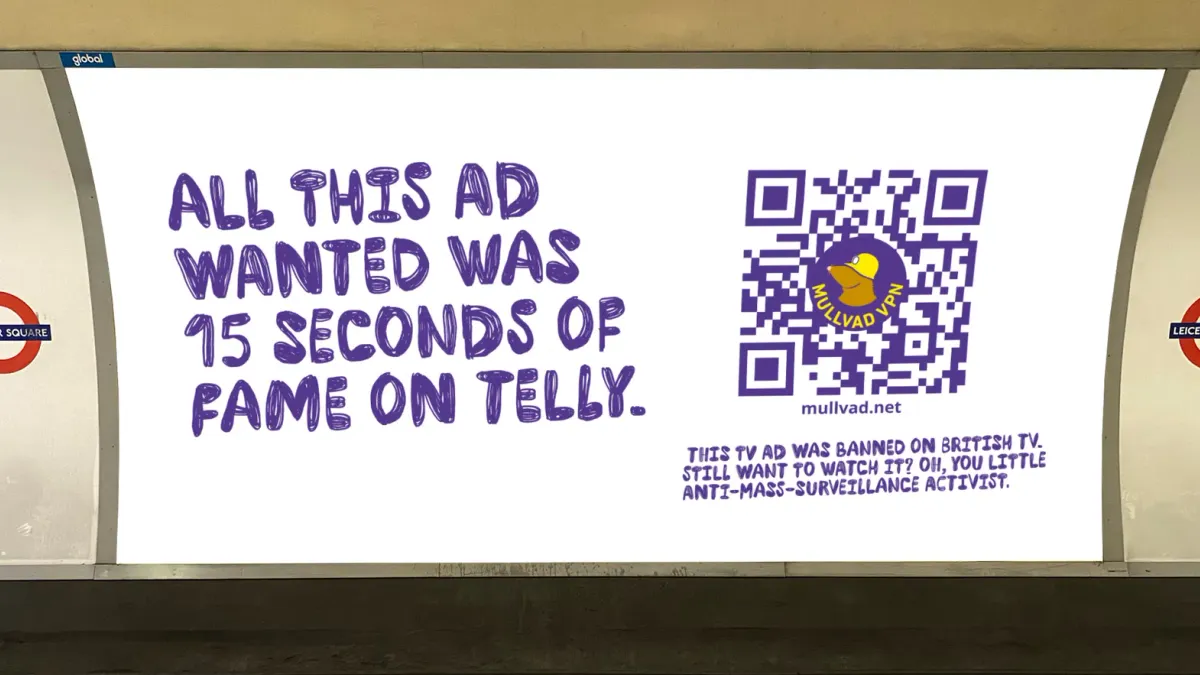
Following the television rejection, Mullvad attempted to continue the conversation through outdoor advertising that referenced the ban itself. However, the wider campaign faced further restrictions, limiting its visibility across public advertising spaces.
This situation highlights how regulatory frameworks can shape the way campaigns appear across different media channels. While outdoor advertising often allows more creative flexibility, politically sensitive messaging can still face scrutiny depending on its content and context.
Advertising and the Boundaries of Debate
The controversy surrounding the campaign raises broader questions about the role of advertising in public discourse. Brands increasingly engage with social and political issues, particularly when those topics relate directly to their services or mission.
For a company focused on privacy protection, highlighting surveillance policies aligns closely with its brand identity. However, campaigns that address policy debates inevitably intersect with regulatory rules designed to ensure advertising remains responsible and clear for audiences.
The balance between encouraging open discussion and maintaining advertising standards is an ongoing challenge for regulators, advertisers and media owners alike.
A Wider Conversation About Privacy
The campaign also arrives at a time when discussions around digital privacy are becoming increasingly prominent. Governments across multiple countries are exploring ways to regulate online platforms, address harmful content and improve digital safety.
In the UK, legislation such as the Online Safety Act reflects these efforts to manage online environments more actively. At the same time, these policies have prompted debate among technology companies, civil liberties groups and privacy advocates about how best to balance safety with individual rights.
Campaigns like Mullvad’s attempt to bring these conversations into the public sphere through creative storytelling.
The Role of Advertising in Public Conversation
The Mullvad campaign demonstrates how advertising can extend beyond product promotion to become part of a broader cultural dialogue. Even when campaigns face restrictions or bans, the attention generated by those decisions can amplify the underlying message and encourage further discussion.
For advertisers, the episode serves as a reminder that campaigns addressing political or regulatory issues must navigate a complex landscape of approval processes, legal frameworks and public interpretation.
For audiences, it illustrates how advertising can sometimes act as a catalyst for conversations that reach far beyond the media space where they were originally intended to appear.