Super Bowl 60 Ads Break Records as Viewership and Engagement Soar
Super Bowl 60 Ads Break Records as Viewership and Engagement Surge
The Super Bowl has long been advertising’s biggest night. In 2026, Super Bowl 60 once again underlined why.
A total of 66 ads aired during the game, three more than the previous year. Thirty second spots reportedly held at approximately $8 million, unchanged from 2025, signalling that demand remains strong even at premium pricing.
While the cost plateaued, the cultural impact did not. Engagement, social chatter and earned media all reached extraordinary levels, reinforcing the Super Bowl as both a broadcast and digital phenomenon.
New Advertisers Enter the Arena
Eighteen brands made their Super Bowl debut this year, a significant influx of first time participants. Among them were AI.com, Genspark, Liquid I.V., Pokémon, Novo Nordisk, Anthropic, Manscaped, Svedka, Ring, Xfinity, Ferrero, Grubhub, Raisin Bran, Fanatics Sportsbook, Boehringer Ingelheim and Ro.
The mix reflects how the Super Bowl has broadened beyond traditional beer, automotive and snack brands. Technology, healthcare, gaming and fintech brands are increasingly using the stage to introduce themselves to mass audiences in a single moment of national attention.
For newer brands especially, the Super Bowl offers instant scale and credibility. The risk is high, but so is the upside.
Engagement Winners and Performance Standouts
According to performance measurement, AI.com’s ad generated 9.1 times the engagement of the median Super Bowl spot, based on metrics including brand search and app downloads. Universal Pictures’ Minions ad followed closely behind with 9.09 times the median engagement.
This highlights an important shift. While creative buzz still matters, advertisers are increasingly measuring real world action. Search spikes, downloads and behavioural signals now sit alongside sentiment and recall when defining success.
In creative terms, analysis suggested that this year’s ads were 9 percent less likely to amuse viewers compared to 2025. However, nostalgia rose as a stronger emotional driver, increasing 7 percent year on year. Brands appear to be leaning into familiarity and cultural memory rather than pure comedy.
Celebrity Saturation Continues
Celebrity involvement reached new heights. Across 39 ads, there were 102 individual celebrity appearances. Familiar faces remain a reliable shortcut to attention in a crowded advertising break, though the sheer volume raises questions about differentiation.
The challenge for brands is no longer simply securing a star, but ensuring the celebrity connection feels earned rather than decorative. With so many recognisable names competing for attention in the same evening, memorability becomes harder to secure.
Social Media: The Real Second Screen
Beyond the broadcast itself, the Super Bowl generated an estimated $550 million in earned media value across social platforms. The event drove 764 billion potential impressions and an engagement rate of 0.19 percent.
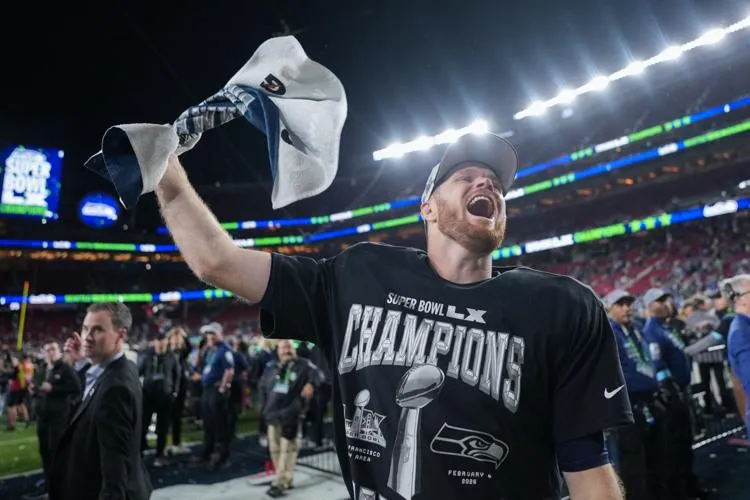
Pepsi emerged as the most mentioned brand on social media with over 38,000 mentions, followed by Apple Music and Budweiser. Conversation peaked around 9.30pm ET when the Seahawks secured victory, generating more than 28 million engagements. Earlier in the evening, Bad Bunny’s halftime performance triggered over 13.5 million engagements in real time.
His full halftime set ultimately produced more than 167 million engagements, significantly surpassing the 80 million generated by Kendrick Lamar’s 2025 performance. The halftime show continues to rival the ads themselves in terms of digital conversation and brand adjacency value.
What Super Bowl 60 Tells Us About Advertising Now
Super Bowl 60 showed that while pricing may have stabilised, the event’s commercial power has not diminished. Record engagement, massive social amplification and measurable behavioural impact demonstrate that the game remains a unique convergence point for mass reach and digital interaction.
Nostalgia is rising. Celebrity use is intensifying. New categories are entering the space. And performance metrics are becoming as important as applause.
For advertisers, the Super Bowl is no longer just about being seen. It is about being searched, shared and acted upon within minutes.
Even at $8 million for half a minute, the world’s biggest advertising night continues to prove its value.