Red Bull brings Tetris to the Dubai sky
by Emily Harris — 24 Dec 2025
4 minute read
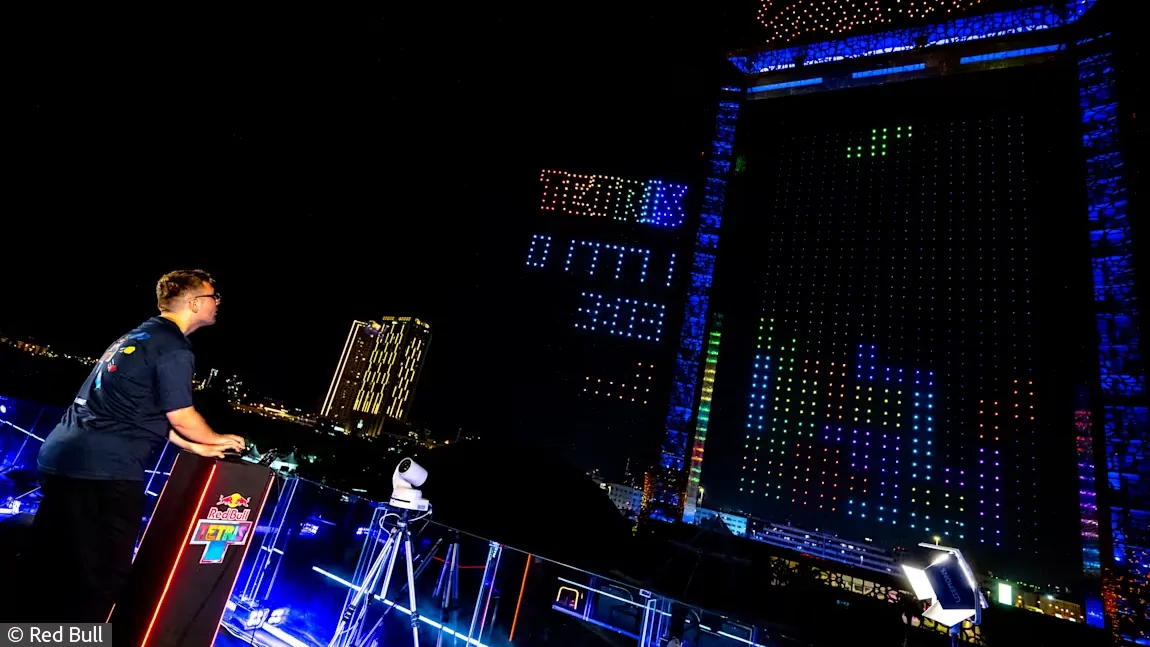
For a brand built on action, adrenaline and culture, Red Bull has a habit of making entertainment feel physical. In December 2025 it did that with a twist that sits neatly at the intersection of esports, outdoor spectacle and brand storytelling. The Red Bull Tetris World Final culminated with a live match played in the night sky above Dubai Frame, with drones forming the falling blocks and reacting to gameplay in real time.
This was not a pre programmed light show dressed up as a tournament. The final itself was the performance, with each move rendered by a coordinated fleet of drones at speed, in open airspace, in front of a live audience. It is the sort of idea that grabs attention instantly because it is simple to understand, visually undeniable, and rooted in a cultural icon almost everyone recognises.
A playable spectacle above Dubai Frame
The location mattered. Dubai Frame, around 150 metres high and 93 metres wide, provided a ready made stage with a clear silhouette and a dramatic sense of scale. It also introduced real operational complexity, including wind pockets and turbulence created by the structure itself, which makes the achievement more than just a clever visual.
Red Bull and its production partners built a bespoke system so the drones could reflect gameplay without lag. According to Red Bull’s behind the scenes breakdown, the drones were refreshing their coordinated positions around 30 times per second, effectively turning thousands of individual aircraft into a single responsive screen.
The headline figure was 4,000 custom drones used across the show, with 2,800 deployed for the grand final match itself, split 1,400 per player. The drones were equipped with high brightness RGB LEDs, designed to be visible from kilometres away in clear conditions.
The story behind the game
The drone final was the peak of a broader global competition. Reporting around the event points to more than seven million qualifying games played worldwide, with national competitions feeding into a final in Dubai featuring players from 60 countries.
In the decisive match, Türkiye’s Fehmi Atalar beat Peru’s Leo Solórzano, posting a final score of 168,566 to 57,164 in a five minute format.
The wider show leaned into Red Bull’s live event DNA, with additional entertainment elements including BASE jumps and live music, which gave the audience more reasons to stay, film, and share.
Why this works as outdoor advertising
Outdoor media performs best when it feels native to public life. Red Bull’s Tetris build did that by turning the city itself into the canvas and making the content genuinely time sensitive. A live match creates natural drama, and drama creates attention. There is also a practical benefit: a spectacle that reads instantly on camera travels fast on social, extending reach without relying solely on paid distribution.
It also demonstrates where outdoor is heading. The line between outdoor, live experience, and broadcast ready content is blurring. A great activation now needs to play well to the crowd on site and to the audience watching through phones, highlights, and press coverage.
What brands can learn from Red Bull’s approach
Make the idea legible in one second. Falling blocks over a landmark needs no explanation.
Build in participation. Interactivity raises perceived value because the audience can see cause and effect.
Choose a landmark that adds meaning. Dubai Frame delivered instant scale and a clean visual frame for the “screen”.
Treat production as part of the creative. A year of planning, bespoke tech, safety and rehearsal are what make these moments feel effortless on the night.
Plan the media journey. A live moment should be captured properly, edited quickly, and distributed with an earned first mindset.
For brands looking at outdoor innovation, the key takeaway is not “use drones”. It is to design outdoor work that people want to watch, film and retell, because the story is the media.
FAQs
Where did Red Bull stage the playable Tetris game in the sky?
The grand final was played above Dubai Frame in Dubai, using the landmark as the stage for the drone display.
How many drones were used for Red Bull’s Tetris event?
Red Bull states 4,000 drones were used across the show, with 2,800 used for the grand final match, split 1,400 per player.
Who won the Red Bull Tetris World Final in Dubai?
Türkiye’s Fehmi Atalar won the inaugural final against Peru’s Leo Solórzano, scoring 168,566 to 57,164.
Why is this campaign relevant for outdoor advertising?
It shows how interactivity, live event energy and a clear visual idea can turn a public space into media that performs on site and online.