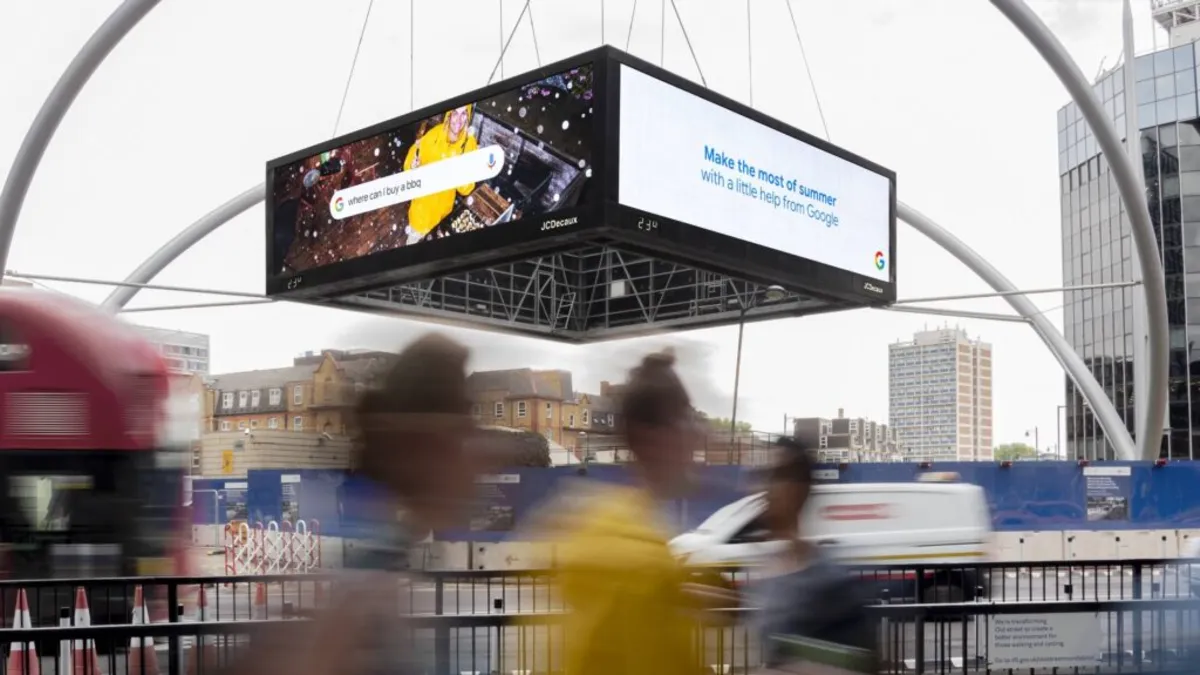
Ultimate guide to Programmatic Advertising
by Harshit Dabhi — 24 Apr 2026
6 minute read
Programmatic advertising is the automated buying and selling of digital ad inventory using software, algorithms, and real-time data. Rather than relying on manual negotiations between publishers and advertisers, programmatic systems execute transactions in milliseconds, matching the right ad with the right audience at precisely the right moment.
Once considered a niche approach, programmatic has become the de facto standard for digital media buying worldwide. In 2014, just over half of global display budgets were transacted programmatically. Today, that figure is approaching 90%, with virtually all net-new display ad spending flowing through automated channels.
Key insight: Programmatic advertising accounted for 96.8% of all net-new global display ad dollars in 2025; non-programmatic channels are essentially stagnant. (Source: eMarketer)
How We've Structured This Guide: 60% DOOH, 40% Digital
This guide reflects where programmatic innovation is most exciting today. We dedicate 60% of our coverage to Digital Outdoor Advertising (DOOH), the fastest-growing, most underutilised, and most transformative channel in the programmatic ecosystem and 40% to core digital programmatic tactics across display, video, mobile, and CTV.
DOOH & Programmatic OOH — 60%
Digital Programmatic — 40%
Billboards · Transit · Airports · Retail · Smart Cities
Display · Video · Mobile · CTV · Native
Digital Out-of-Home (DOOH): The Programmatic Frontier
Digital outdoor advertising refers to dynamic, internet-connected advertising displays in public spaces, from motorway digital billboards and airport screens to shopping centre kiosks, lift displays, and smart city panels. When combined with programmatic technology, Digital outdoor advertising becomes a precision marketing tool capable of real-time audience targeting, contextual triggers, and measurable attribution.
Market scale: The global DOOH advertising market was valued at $20.2 billion in 2025 and is projected to reach $56.1 billion by 2034, growing at a CAGR of 12.09%. (Fortune Business Insights)
Global investment in DOOH grew by 15% in 2024 and is forecast to expand further 14.9% in 2025, reaching $17.6 billion in programmatic DOOH specifically, according to WARC. North America leads with a 33–37% market share, whilst Asia-Pacific is the fastest-growing region driven by rapid urbanisation, smart city investment, and surging mobile connectivity.
Why Programmatic DOOH Is the Channel Marketers Can't Ignore
Programmatic DOOH (pDOOH) enables advertisers to buy outdoor screens in real-time, applying the same audience-led, data-driven logic as digital display. Creative can respond dynamically to triggers, weather, footfall, time of day, and sporting results, making outdoor advertising as agile as any digital channel.
Consumer impact: A 2024 OAAA and Harris Poll study found that 73% of consumers view DOOH ads favourably, rating them higher than television (50%), social media (48%), and online ads (37%). Furthermore, 76% of viewers took action after seeing an outdoor advertisement.
In North America, programmatic buying now accounts for over 70% of all DOOH ad spend, and the broader global pDOOH market is projected to grow from $3.37 billion in 2025 to an extraordinary $65.6 billion by 2035 at a CAGR of 39.12%.
Real-Time Bidding (RTB)
Dynamic Creative Optimisation
Contextual Triggers
Geotargeting
AI-Driven Audience Segments
Cross-Channel Attribution
- Supply-Side Platforms (SSPs) list DOOH inventory
Operators such as JCDecuax, Clear Channel, and Lamar make their digital screen networks available programmatically via SSPs like Vistar Media, Broadsign, and Viooh.
- DSPs submit bids based on audience and context
Advertisers use Demand-Side Platforms to define audiences' demographic, behavioural, or location-based and bid in real time for relevant screen slots.
- Creative adapts dynamically in milliseconds
Approximately 45% of advanced DOOH deployments now switch creative dynamically based on footfall, weather, and event triggers in real time.
- Attribution closes the loop
Mobile device-level matching and sales uplift studies tie DOOH exposure to downstream conversion events, providing measurable ROI.
Notable deal: In early 2025, T-Mobile announced the acquisition of Vistar Media for USD 600 million, gaining access to real-time DOOH technology and 1.1 million digital screens, underscoring the strategic value of programmatic OOH infrastructure.
Core Digital Programmatic: Display, Video, Mobile & CTV
While DOOH is the emerging star, the foundational digital programmatic ecosystem spanning display banners, online video, mobile advertising, and Connected TV remains the largest and most mature segment. In 2024 alone, global programmatic ad spend across these digital channels reached an estimated $833 billion and is expected to reach $4.4 trillion by 2032.
- Display & Native
Banner, rich media, and native formats. RTB dominates with a 42% market share. PMPs are growing at 26% CAGR.
- Programmatic Video
Pre-roll, mid-roll, outstream. Connected TV (CTV) is the fastest-growing sub-channel, particularly in North America.
- Mobile
Mobile accounts for the majority of programmatic impressions globally, driven by app-based inventory and location data.
- Retail Media
Programmatic retail display grew 41.7% in 2024, projected to exceed $30B by 2026 as brands target high-intent shoppers.
The top three global programmatic markets remain the United States ($264.7B), China ($157.5B), and the United Kingdom ($41.7B). North America as a whole commands roughly 33% of global spend, with Asia-Pacific growing at the fastest CAGR of 25%, driven by smartphone adoption and e-commerce expansion.
Challenges, Privacy & the Cookieless Transition
The programmatic ecosystem is undergoing fundamental structural change. Third-party cookie deprecation has pushed the industry toward first-party data strategies, contextual targeting, and privacy-safe identifiers. Simultaneously, ad fraud remains a persistent concern, and losses were projected to reach $81 billion globally in 2024.
Transparency push: Private Marketplaces (PMPs) are growing at a CAGR of nearly 26% as advertisers seek brand-safe, fraud-resistant environments over the open web. AI-powered verification tools are becoming standard practice.
For global marketers, navigating regulatory frameworks such as GDPR in Europe, CCPA in California, and evolving data localisation laws across Asia-Pacific and the Middle East requires a platform-agnostic, consent-first data architecture. Brands investing in clean room technologies and direct publisher relationships are best positioned to thrive in this environment.
First-Party Data
Contextual Targeting
Clean Rooms
GDPR / CCPA Compliance
Universal ID Solutions
Strategy
Building an Integrated Programmatic Strategy for 2025 and Beyond
The most effective global campaigns no longer silo DOOH from digital. Instead, they treat the full programmatic stack as a unified, omnichannel system using DOOH for mass awareness and contextual relevance, and digital channels for personalisation, retargeting, and conversion.
- Define audience segments across all channels
Build audience profiles using first-party CRM data, contextual signals, and location data applicable to both DOOH targeting and digital bidding.
- Activate DOOH for awareness & context
Use pDOOH to deliver dynamic, location-aware creative in high-footfall environments. Leverage weather and event triggers for maximum contextual relevance.
- Retarget DOOH-exposed audiences digitally
Mobile device graphs allow you to identify users who passed a DOOH screen and serve sequential digital ads, completing the awareness-to-conversion journey.
- Measure holistically, not in silos
Adopt unified measurement frameworks that capture DOOH attribution alongside digital metrics, enabling true cross-channel ROI analysis and budget optimisation.
- Invest in AI and automation tools
AI-driven bidding and creative optimisation are table stakes. Platforms incorporating machine learning outperform manual buying on cost efficiency and audience match rates.
With global spend forecast to exceed $4.4 trillion by 2032 and pDOOH growing at 39% annually, the brands that invest in programmatic infrastructure today will define the advertising landscape of tomorrow.